The human capital sector is entering a new phase of consolidation, one increasingly driven by platform scale, AI-enabled infrastructure, and recurring advisory revenue. Hunt Scanlon Ventures’ latest Q1 M&A report examines how buyers are repositioning talent businesses around long-term value creation, and why leadership strategy is becoming central to enterprise performance.
Hunt Scanlon Ventures’ 2026 Human Capital Markets Update: Q1 M&A Report points to a market undergoing rapid institutionalization. Human capital M&A is no longer centered around standalone recruiting firms or opportunistic acquisitions. Instead, buyers are consolidating around integrated platforms that combine executive search, leadership advisory, workforce analytics, succession planning, and AI-enabled infrastructure.
The shift reflects a broader change in how talent is valued.
Across private equity, healthcare, financial services, and technology, workforce strategy is increasingly being treated as a core operational and investment lever rather than a traditional HR function. Firms that can connect leadership and workforce performance to measurable business outcomes are commanding stronger valuations and attracting growing investor interest.
Download the full M&A report here: huntscanlonventures.com/2026-q1-ma-report.
From Search Firms to Talent Platforms
One of the clearest themes throughout the report is the transition from fragmented service providers to integrated talent platforms. “Buyers are prioritizing scalable businesses with embedded technology, recurring advisory relationships, and broader operating capabilities rather than firms built solely around placement revenue,” said Scott A. Scanlon, founder and co-CEO of Hunt Scanlon Ventures.
“Workforce strategy is now firmly embedded in enterprise value creation,” said Drew Seaman, HSV managing director. “Leadership succession, workforce capability, and talent concentration risk are no longer HR considerations — they are board-level priorities directly tied to valuation durability.”
That shift is changing how firms are built and how they are valued. Advisory-led platforms with embedded analytics and recurring revenue models are increasingly trading at structurally higher multiples than traditional recruiting businesses.
At the same time, AI is accelerating the institutionalization of talent intelligence. Capabilities such as sourcing automation, workforce analytics, and skills mapping are quickly becoming baseline expectations across the sector. The market is moving toward integrated “decision intelligence” models that combine data, predictive analytics, workflow automation, and advisory services into a unified operating system.
Leadership Advisory Draws Institutional Capital
The report also highlights a significant acceleration of private capital into leadership advisory and assessment businesses. KKR’s minority investment in ghSMART and Advent International’s investment in Heidrick & Struggles reflect a growing belief that leadership advisory represents an increasingly attractive investment category within professional services.
“Buyers are prioritizing scalable businesses with embedded technology, recurring advisory relationships, and broader operating capabilities rather than firms built solely around placement revenue.”
Taken together, these transactions signal a broader realization among investors: leadership firms combine durable client relationships, recurring engagement, and expanding demand from both boards and private equity sponsors navigating increasingly complex operating environments.
“Viewed through a wider lens, it is AI that presents the biggest opportunity for talent assessment within this highly specialized human capital vertical,” said Mr. Scanlon. “We believe AI-enabled assessment will be the predominant growth leader within human capital by 2030.”
The influx of institutional capital is also reshaping competition at the top of the market. Access to private equity funding enables firms to accelerate investment in AI, analytics, and broader advisory capabilities at a pace that many traditional partnerships may struggle to match.
Women-Founded Firms Gain Strategic Attention
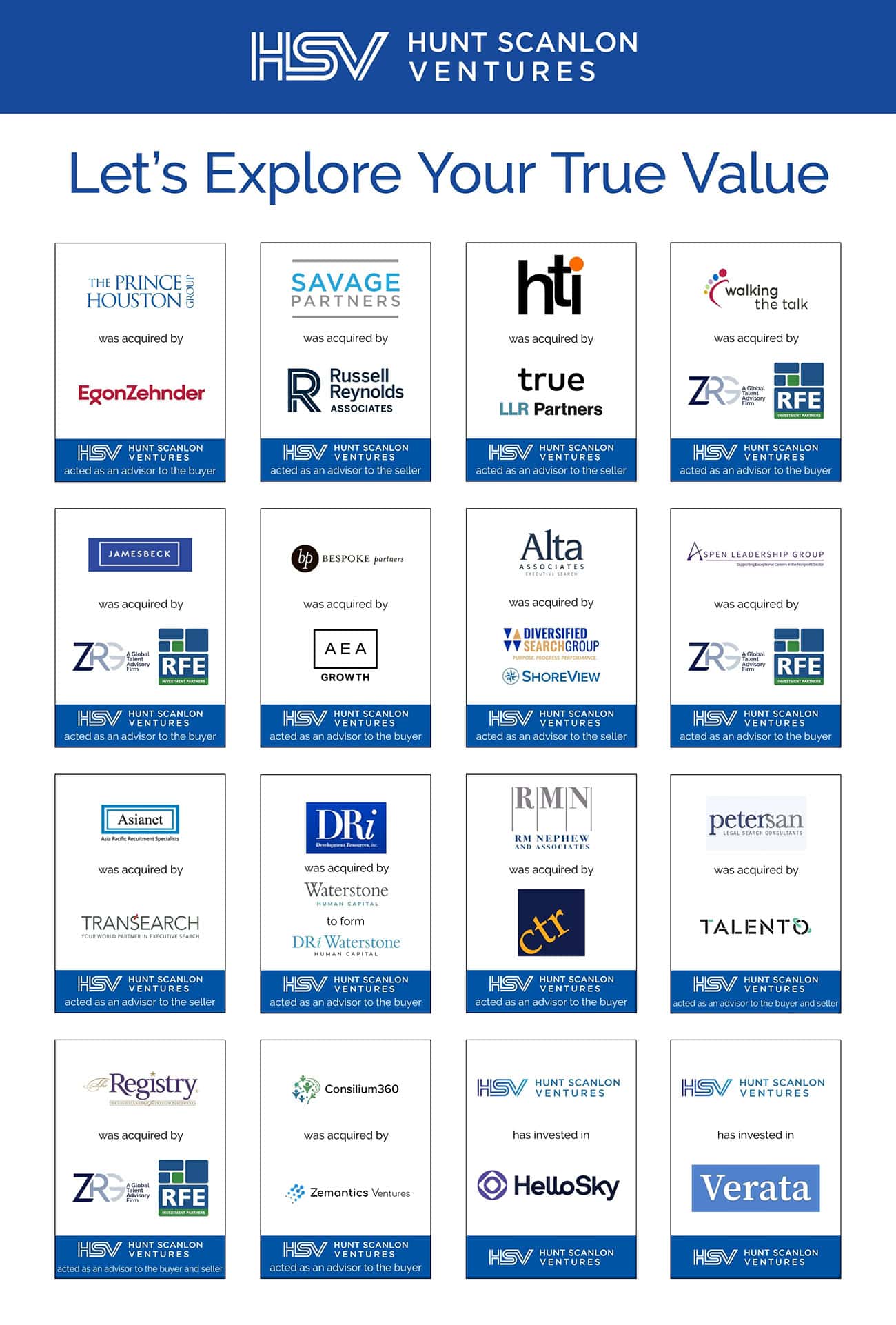
Another notable trend outlined in the report is the growing strategic interest in women-founded executive search firms. Hunt Scanlon Ventures notes that eight of its last 24 transactions involved female-founded businesses, reflecting what the firm describes as a structural shift rather than a symbolic one.
These firms are increasingly attractive acquisition targets because they often combine specialization, founder-led growth, durable client relationships, and advisory-driven business models.
“They are often built in ways that align more closely with how leadership hiring operates today: relationship-driven, advisory-led, and embedded within sector ecosystems,” said Mr. Seaman.
The appeal extends well beyond diversity narratives. Buyers are prioritizing businesses that can scale while maintaining strong client engagement and differentiated positioning within niche markets.
AI Reshapes the Economics of Talent
The report reinforces that AI is no longer experimental within the human capital ecosystem. Search firms, leadership advisors, and workforce platforms are increasingly embedding AI into sourcing, assessment, analytics, and workflow automation.
“Viewed through a wider lens, it is AI that presents the biggest opportunity for talent assessment within this highly specialized human capital vertical. We believe AI-enabled assessment will be the predominant growth leader within human capital by 2030.”
At the same time, the economics of the sector are shifting away from transactional recruiting and toward recurring, performance-based models. Buyers are increasingly seeking portfolio-wide talent solutions that include succession planning, leadership architecture, and post-placement performance measurement.
“The focus has shifted from building larger search firms to constructing integrated human capital operating systems,” said Mr. Scanlon.
This transition is reshaping the entire sector. Subscription-based intelligence models and embedded advisory relationships are creating more durable revenue streams, while AI-enabled infrastructure is becoming a key differentiator in both valuation and scalability.
The Next Phase of Consolidation
The report suggests that the sector may be entering its most transformative period in decades. M&A interest remains elevated, with firms actively pursuing acquisitions and many more evaluating opportunities over the next several years. At the same time, only a small percentage of firms are actively seeking to be acquired, creating a market driven more by strategic expansion than distress.
As buyers continue prioritizing specialization, scalable infrastructure, and integrated advisory capabilities, competition for high-quality platforms is expected to intensify.
For executive search firms and leadership advisory businesses, the implication is clear. The market is increasingly rewarding firms that can combine technology, recurring intelligence, and advisory depth into scalable operating models.
The future of human capital M&A will not be defined by who can fill roles fastest. It will be defined by who can build the most durable talent platforms.
Article By

Leo Cummings
Leo Cummings is Editor of ExitUp, the investment blog from Hunt Scanlon Ventures designed for professionals across the human capital M&A sector. Leo serves as an Associate for Hunt Scanlon Ventures, providing robust industry research to support the firm’s investment group.